
Immunological Regulation and Pathogen Response
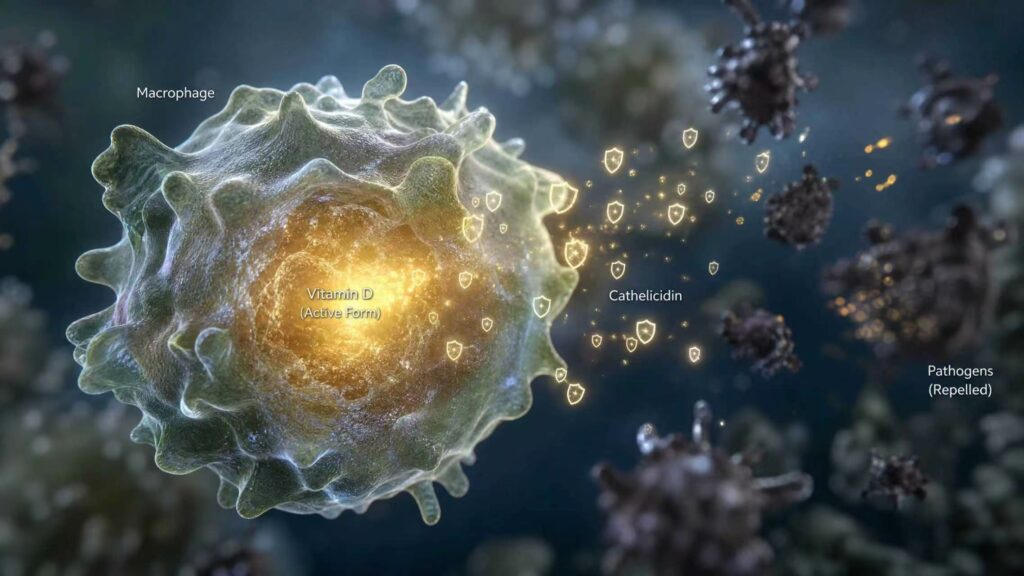
A landmark 2006 study published in Science fundamentally revised standard immunological models. Researchers identified that macrophages possess the localized capability to activate the entire vitamin D enzymatic pathway upon encountering pathogens-a function previously believed to be exclusively renal. These immune cells sequester circulating precursors to synthesize active vitamin D internally, leveraging it to deploy targeted antimicrobial defenses.
Precision in Immune Function
Optimal immune architecture prioritizes precision over sheer magnitude. The system must rapidly neutralize external threats such as viruses and bacteria while maintaining strict tolerance toward healthy autologous tissue. Weakened responses result in chronic infections, whereas hyperactive responses precipitate autoimmune conditions and systemic inflammation. D3 maintains immunological homeostasis by modulating both extremes.
Innate Immunity: Localized Activation
Tissue-resident macrophages initiate the primary defense against penetrating pathogens. When Toll-like receptors (specifically the TLR2/1 heterodimer) detect pathogenic molecular patterns, they trigger an immediate intracellular cascade.
TLR2/1 Activation → VDR Upregulation + CYP27B1 (1α-hydroxylase) Upregulation
This upregulation grants macrophages independent synthetic capability. The cells draw 25(OH)D from the bloodstream, utilizing intracellular CYP27B1 to convert it directly into 1,25(OH)₂D. This generates localized hormone concentrations far exceeding standard systemic levels, prompting two critical defensive mechanisms:
- The transcription of the cathelicidin (LL-37) gene. LL-37 serves as a potent broad-spectrum antimicrobial peptide capable of dismantling the lipid membranes of bacteria and viruses.
- The expression of the β-defensin-2 (DEFB4) gene, which reinforces epithelial barriers against further pathogenic infiltration.
Experimental models involving DSS-induced colitis demonstrate that mice lacking the Cyp27b1 gene suffer severe weight loss and overwhelming IL-1β cytokine storms. This confirms the absolute necessity of localized vitamin D synthesis for mucosal immune integrity.
Substrate Availability Constraints
Macrophage defensive capacity is mathematically limited by systemic 25(OH)D concentrations. At a serum level of 15 ng/mL, activated macrophages simply lack the raw substrate required to synthesize adequate 1,25(OH)₂D, rendering TLR distress signals ineffective. In such cases, susceptibility to infection stems from an acute substrate deficit rather than an inherent immune defect.
Epidemiological data consistently show that infection rates for respiratory syncytial virus, influenza, and COVID-19 surge during winter months, mirroring the seasonal nadir in population-wide vitamin D levels.
Adaptive Immunity: Modulating T-Cell Activity
While innate immunity relies on D3 for defensive escalation, adaptive immunity utilizes it for essential deceleration. During pathogen engagement, 1,25(OH)₂D exerts precise regulatory control over T-cell differentiation:
· It restricts the uncontrolled proliferation of Th1 and Th17 phenotypes, mitigating the cellular autoreactivity responsible for conditions like rheumatoid arthritis and multiple sclerosis.
· It expands the regulatory T cell (Treg) population by upregulating FOXP3 transcription, enhancing endogenous immunosuppressive capacity.
· It preserves dendritic cells in a tolerogenic state, lowering the probability of inappropriate immune activation.
It physically binds to the p65 subunit of NF-κB via the VDR complex, directly terminating downstream pro-inflammatory signaling cascades.
Clinical Literature Review
Study / Trial | Methodology & Scale | Primary Outcomes |
BMJ Meta-Analysis (2017) | n=11,321; 25 RCTs | Supplementation lowered acute respiratory infection risk. Maximum protective effect (OR 0.58) observed in cohorts with baseline <10 ng/mL. |
VITAL Autoimmune Subgroup | n=25,871; 5.3-year follow-up | Daily 2,000 IU regimens reduced aggregate autoimmune incidence by 22% (HR 0.78, p=0.02). Represents the highest tier of current RCT evidence. |
VIVID Trial (COVID-19) | Mass General Brigham cohort | High-dose intervention did not alter acute severity; however, compliant participants reported lower rates of persistent symptoms at 8 weeks (21% vs. 25% placebo). |
Limitations in Reversal
While the VITAL trial robustly demonstrated D3’s efficacy in reducing autoimmune disease incidence, robust large-scale RCT data does not currently support its ability to reverse established autoimmune pathology. High-dose experimental frameworks, such as the Coimbra Protocol (discussed in Article 6), provide preliminary case-series data but lack definitive Phase III validation.