
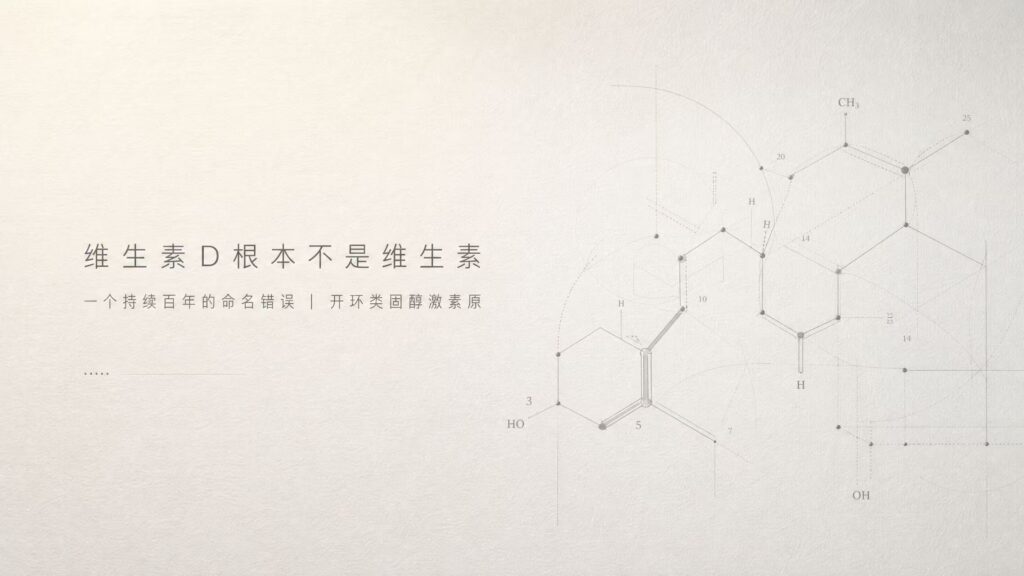
Let's rethink vitamin D.
A Naming Error That Has Lasted a Hundred Years
When was the last time you really thought about what “Vitamin D” actually is?
It might have been the fine print on a calcium supplement label, a casual reminder in a physical exam report to “get more sun,” or maybe—never at all.
In 2019, Jikei University School of Medicine in Tokyo screened 5,518 healthy adults using LC-MS/MS, the gold-standard method. The result: 98% of subjects had serum vitamin D levels below 30 ng/mL.
Modern urban life is creating an epidemic of vitamin D deficiency, and chances are you are right in the middle of it.
A Name That Has Been Wrong for a Hundred Years
In 1922, Elmer Verner McCollum (March 3, 1879 – November 15, 1967), an American biochemist, discovered a fat-soluble substance in cod liver oil that could cure rickets. He named it “Vitamin D.” That name has since been printed into textbooks, packed into capsules, and written on every physical exam report. But it was wrong from the very beginning.
- The definition of a vitamin has two hard requirements: the human body cannot synthesize it, and it must be obtained from food.
- Vitamin D3 fails on both counts. Your skin stores 7-dehydrocholesterol—when UVB rays at wavelengths of 290–315 nm from sunlight hit the skin, an endogenous synthesis process automatically kicks in, without you needing to eat anything at all.
This sunlight-driven steroid synthesis pathway has been running for over 500 million years, embedded in the genetic network of vertebrates since the earliest jawed fish.
So What Is It, Really?
The precise classification of vitamin D3 (cholecalciferol) is — seco-steroid prohormone.
“Seco-steroid” is the most accurate description of its molecular structure. Its B-ring is open, which sets it apart from the closed-ring structures of classic steroid hormones like estrogen, testosterone, and cortisol. Yet its metabolic pathways, receptor distribution patterns, and signal transduction mechanisms are highly consistent with those hormones.
It is not a nutrient—it is a signaling molecule: a regulatory command network spanning over 200 cell types.
Why Its Impact Far Exceeds Your Imagination
Nearly every nucleated cell in the human body carries the vitamin D receptor (VDR). VDR belongs to the nuclear receptor superfamily, the same family as thyroid hormone receptors and retinoic acid receptors. This means the active form of vitamin D does not act on a single pathway—it is systematically embedded in the gene expression network.
VDR Distribution | D3 Regulatory Function Here |
Cerebral cortex, hippocampus, substantia nigra | Memory, mood, motivation, neurogenesis |
Cardiomyocytes, vascular smooth muscle, endothelial cells | Blood pressure regulation, vascular function, cardiac contraction |
T cells, B cells, macrophages, dendritic cells | Immune system activation and suppression timing |
Pancreatic β cells | Insulin secretion, blood glucose homeostasis |
Ovaries, testes, placenta | Sex hormone synthesis, fertility regulation |
Osteoblasts, osteoclasts | Bone health (classical understanding) |
One molecule, reaching every corner of the body. This is a biological fact, not marketing rhetoric.
What You Need to Know First
When serum vitamin D levels are insufficient, the problem is not with a single system—it is with every system in the table above. This article is not a “eat more of this” kind of advice; it is a reset of your cognitive starting point.
The next five articles will dive deeper, layer by layer:
- How it is activated in the body — a rigorous two-step unlocking procedure
- How it commands the immune system — your immune cells can “locally manufacture” active vitamin D
- How to know if you have enough — one blood test is more useful than a hundred articles
- Why your supplements might be wasted — K2, magnesium, and the cofactor network most discussions ignore
- Your personal action system — a complete plan from testing to supplementation, from dosing to monitoring
After reading, you will never call it a “vitamin” again.